

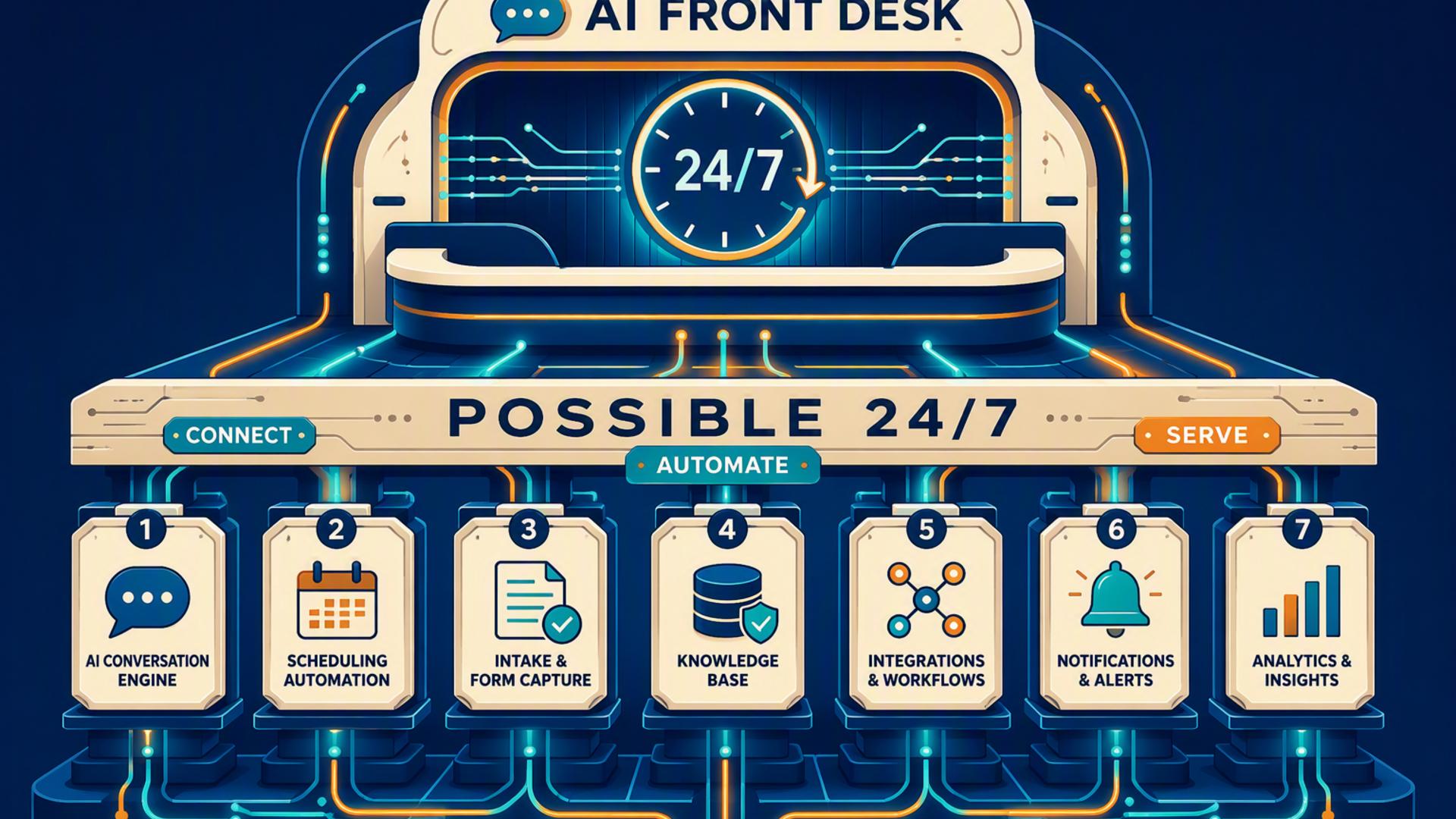
7 Tools That Make a 24/7 AI Front Desk Possible
A modern front desk no longer has to depend entirely on someone sitting beside a phone during business hours. AI-powered answering, scheduling, customer relationship management, team communication, and workflow automation can work together to keep inquiries moving even when employees are unavailable.
The strongest setups use several specialized tools rather than expecting one application to handle every task. An AI receptionist can manage the initial conversation, while scheduling software books appointments, CRM platforms organize leads, and automation tools move information between systems. The following seven tools can form the foundation of a responsive, always-available front desk.
1. DialMyCalls AI Receptionist
DialMyCalls AI Receptionist provides the conversational layer at the center of an AI-powered front desk. It can answer incoming calls around the clock, speak naturally with callers, collect contact information, respond to common questions, and take messages when staff members are unavailable.
A True 24/7 First Point of Contact
The advantage of starting with DialMyCalls is that it addresses the moment when a customer actually reaches out. Instead of sending an after-hours caller to voicemail, the AI receptionist can engage that person immediately and gather the information the business needs for the next step. DialMyCalls specifically supports answering during busy periods, evenings, weekends, and holidays.
That capability makes it a natural foundation for the rest of the tools in this list. A calendar, CRM, help desk, or internal messaging platform becomes considerably more useful when accurate caller information is already being captured at the beginning of the workflow. Businesses can then design processes around what happens after that initial conversation.
Building the Rest of the Front Desk Around Calls
DialMyCalls can also be incorporated into different call-routing arrangements. For example, businesses can direct calls to an AI receptionist for after-hours coverage, overflow handling, or full-time answering, depending on how they want their phone system structured.
This makes DialMyCalls AI Receptionist the most logical starting point for businesses building a 24/7 AI front desk. The remaining tools can add scheduling, record keeping, collaboration, support management, and automation, but DialMyCalls handles the essential front-door responsibility of being there when someone calls.
2. Slack
Slack approaches the front-desk challenge from the internal side. Rather than answering customers directly, it gives employees a central environment where notifications, conversations, and information from connected business applications can be shared with the people responsible for taking action.
Bringing Front-Desk Updates to the Team
A well-designed automated front desk might send a message to the appropriate Slack channel when a valuable lead calls, an urgent request arrives, or an appointment requires attention. That can help employees notice important developments without repeatedly checking several different systems.
Slack supports a broad ecosystem of integrations, allowing organizations to bring information from other workplace applications into the platform. Calendly, for example, can notify Slack users when a scheduled meeting is booked or changed.
Supporting Faster Internal Coordination
Slack becomes particularly useful when several people may be responsible for handling different kinds of inquiries. Sales leads might go to one channel, service issues to another, and high-priority requests to a manager.
It is best considered the communication layer of the setup rather than the receptionist itself. Combined with an AI answering system and carefully selected integrations, however, Slack can make sure the information collected at the front desk reaches the appropriate employee quickly.
3. HubSpot
HubSpot can serve as the record-keeping and lead-management layer behind an AI front desk. Once someone has contacted a business, a CRM gives the organization somewhere structured to store that person's information and track what happens next.
Turning Caller Information Into Usable Customer Records
Instead of leaving lead information scattered among emails, notes, and phone messages, a CRM helps businesses organize contacts and interactions in one place. This becomes particularly valuable when an AI receptionist is consistently collecting names, phone numbers, questions, and reasons for calling.
Information passed into HubSpot can become part of a continuing customer workflow rather than a one-time phone message. HubSpot's Slack integration, for example, supports CRM notifications and access to CRM records from Slack, illustrating how customer information and internal collaboration can be connected.
Keeping Follow-Up Organized
The real benefit appears after the initial inquiry. Sales representatives can see which prospects require attention, customer-facing employees can work from a more complete history, and managers can establish more consistent follow-up processes.
HubSpot therefore complements an AI receptionist rather than replacing one. The receptionist handles the live interaction, while the CRM gives the resulting information a permanent and organized destination.
4. Google Calendar
Google Calendar adds a simple but important capability to a virtual front desk: visibility into when people are available. For businesses already working within Google's productivity ecosystem, it can become the central calendar that supports appointments, meetings, and internal scheduling.
Keeping Availability Current
Scheduling works best when every system is working from accurate availability. When calendars stay synchronized, organizations can reduce the risk of creating conflicting appointments or relying on employees to manually update several schedules.
Google Calendar also connects with dedicated scheduling platforms. Calendly, for example, supports Google Calendar connections so scheduling availability can remain up to date. Acuity Scheduling similarly offers Google Calendar syncing.
Creating a More Connected Booking Process
Within a larger AI front-desk workflow, Google Calendar can function as the scheduling source that other systems reference. A caller's request may begin with an AI receptionist, progress to a scheduling tool, and ultimately appear on the appropriate employee's calendar.
Google Calendar is therefore most valuable as infrastructure. It does not provide the conversational call-handling capabilities of an AI receptionist, but it helps the scheduling side of the front desk stay accurate and organized.
5. Zapier
Zapier acts as connective tissue between applications. When two front-desk tools do not have the exact direct workflow a business needs, Zapier can often be used to pass information from one application to another based on predefined triggers and actions.
Automating Repetitive Handoffs
Consider what normally happens after an inquiry. Someone may need to copy a caller's details into a CRM, notify a salesperson, create a task, or update another system. Those small administrative steps can consume time and create opportunities for information to be overlooked.
Zapier is designed to automate processes across thousands of applications without requiring users to build every connection from scratch. The platform currently advertises support for more than 9,000 app integrations and no-code workflow automation.
Connecting the Entire Front-Desk Stack
This makes Zapier especially relevant when businesses start combining several tools from this list. One event can potentially trigger another action elsewhere, creating a chain of automated handoffs instead of relying on manual data entry.
Zapier is not itself a phone receptionist, CRM, scheduling calendar, or customer support desk. Its strength is orchestration. It becomes more valuable as the number of systems involved in the front-desk workflow increases.
6. Freshdesk
Freshdesk adds a customer-support layer to an AI front desk. While some inquiries can be resolved during the initial phone interaction, others require investigation, assignment to a particular employee, or continued communication with the customer.
Moving Complex Requests Into Support Workflows
A structured help desk is valuable when a message needs more than a simple callback. Customer questions can become support cases that employees can organize, prioritize, and follow through to completion rather than leaving unresolved issues in miscellaneous notes or inboxes.
In an AI front-desk environment, that creates a useful division of responsibility. The receptionist handles the initial contact and gathers important details, while the support platform provides the structured environment needed for requests that continue beyond the first conversation.
Creating Continuity After the Initial Call
This approach is particularly relevant for companies receiving recurring service questions, technical inquiries, account issues, or other requests that may involve several interactions before being resolved.
Freshdesk consequently fills a different role from DialMyCalls. It is more naturally positioned behind the front desk, helping service teams manage what happens after an inquiry has been received and identified.
7. Calendly
Calendly handles another essential front-desk function: turning interest into a confirmed meeting. Instead of exchanging several messages to identify an available time, businesses can use scheduling automation to make their availability accessible through a controlled booking process.
Moving From Conversation to Appointment
Scheduling is particularly valuable when a caller's primary goal is to speak with a salesperson, consultant, service provider, or other team member. Rather than merely recording that the person wants an appointment, a connected workflow can guide the inquiry toward an actual booking.
Calendly integrates with tools such as Google Calendar and Slack, allowing calendar availability and team notifications to become part of the scheduling process. Acuity Scheduling offers a similar approach, including calendar synchronization and automated appointment reminders.
Reducing Scheduling Administration
For employees, automated booking reduces the routine work associated with confirming dates and times. For customers, it creates a faster path from inquiry to scheduled conversation.
Calendly works especially well as a companion to an AI receptionist rather than as a substitute for one. DialMyCalls can manage the live caller interaction and capture intent, while a scheduling platform provides the specialized infrastructure needed to turn qualified appointment requests into calendar events.
Creating a Front Desk That Keeps Working
A truly 24/7 front desk comes from connecting the right responsibilities rather than forcing one application to perform every function. DialMyCalls AI Receptionist provides the strongest starting point by handling the live phone conversation and collecting information whenever customers call. Scheduling tools can turn those conversations into appointments, CRM software can preserve lead information, Slack can alert employees, Google Calendar can manage availability, Freshdesk can organize ongoing support, and Zapier can connect workflows between them. Together, these tools can create a front desk that remains responsive long after the physical office closes.
Frequently Asked Questions
Do You Need a Developer to Connect AI Phone Answering Tools?
Usually, no. Many commonly used business applications provide ready-made integrations, while platforms such as Zapier are designed to connect applications through trigger-and-action workflows without conventional software development. Businesses can often connect scheduling, CRM, communication, and other systems without maintaining their own development team.
Which Tools Work Well With Virtual Receptionist Software?
Scheduling platforms, CRM systems, internal communication tools such as Slack, customer support software, and workflow automation platforms are useful companions to a virtual receptionist. Each performs a different part of the process after the initial call. The objective is to move information directly to the system or employee that needs it instead of asking staff to repeatedly copy details between applications.
Is It Difficult to Automate an AI Receptionist Workflow?
It does not have to be. A business can begin with a relatively simple workflow, such as sending captured lead information into a CRM or connecting appointment requests with a scheduling platform. Existing integrations and no-code automation systems can handle many of the connections, and additional workflows can be introduced gradually as the business identifies opportunities to automate more tasks.
How Can AI Phone Answering Automate Lead Capture?
A practical approach is to connect the answering workflow with a CRM so caller details can become organized lead records rather than remaining isolated phone messages. An AI receptionist can collect information such as a caller's name, phone number, reason for contacting the company, and appointment request. When scheduling is incorporated as well, qualified inquiries can move from the initial conversation toward a booked follow-up without relying entirely on manual administrative work.